

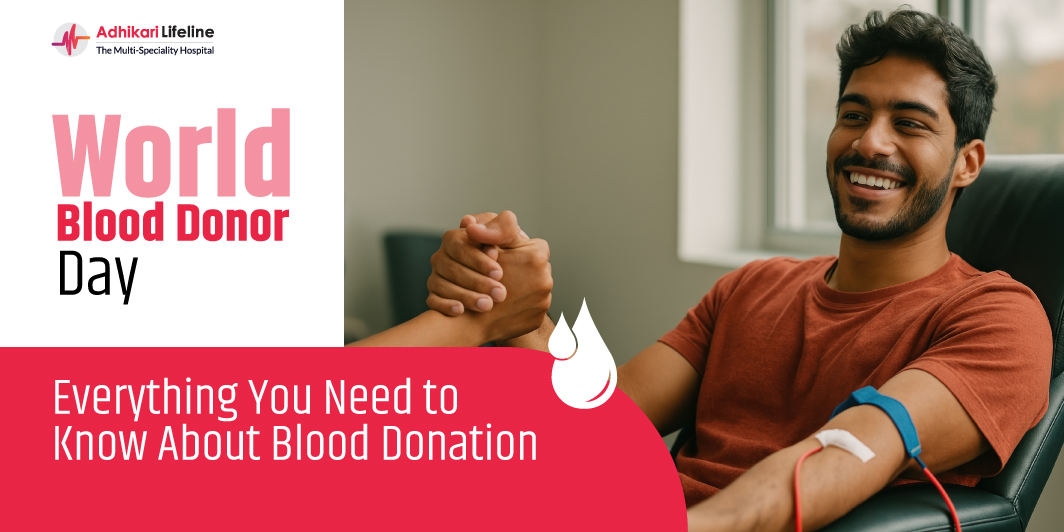
Every year, 14th June is marked as World Blood Donor Day, a day dedicated to raising awareness of the critical need for safe blood donations and to thank voluntary, unpaid blood donors for their life-saving gifts of blood. This global event, observed by the World Health Organization and supported by health authorities worldwide, is not just a formality; it is a crucial reminder of an ongoing need, and an opportunity to celebrate heroes who give the gift of life: blood donors.
At Adhikari Lifeline Hospital, our Blood Bank in Boisar encourages active blood donation camps in and around Boisar to educate and spread awareness on the needs and benefits of blood donation to individuals. Let us help you learn more about blood donation and what makes it a noble, life-saving act for humankind. Let’s begin.
Why Blood Donation Matters
Blood is irreplaceable. There is currently no synthetic alternative—human blood is essential for survival in a wide range of medical situations. Whether it is for emergency trauma cases, surgeries, cancer therapies, childbirth complications, severe anemia, or chronic illnesses requiring transfusions, blood keeps the hospital wheels turning. According to health experts, every two seconds someone in the world needs a blood transfusion.
Shortages in blood supply can mean the difference between life and death. Blood cannot be stored indefinitely; red blood cells, platelets, and plasma each have their own shelf lives, meaning a constant stream of donations is necessary. This makes voluntary blood donors vital partners in the healthcare system, supporting patients they may never meet. By focusing on blood donation, World Blood Donor Day highlights the urgency of this cause, dispels myths, and educates the public on the immense effects of their donations.
How One Blood Donation Saves Three Lives
There is a common and powerful fact echoed by blood banks and hospitals: one single blood donation can save up to three lives. How is this possible? A standard blood donation is separated into three components—red blood cells, platelets, and plasma. Each of these components addresses different medical needs.
- Red blood cells are often transfused in cases of severe blood loss or anemia.
- Platelets are essential for patients undergoing cancer treatment or major surgeries.
- Plasma is vital in treating burns, shock, and certain clotting disorders.
Because of this ability to split a donation into multiple components, your single act of kindness becomes a triple blessing. You may help a child fighting leukemia, a mother recovering from childbirth complications, and an accident victim all with one visit to a blood bank. This is why every donor holds the power to transform—not just one, but several lives.
Who Can Donate Blood?
Blood donation is inclusive; most healthy adults can become donors. However, adherence to specific eligibility criteria ensures both the donor’s safety and the quality of blood supplied. General guidelines include:
- Age: Typically, donors must be between 18 and 65 years old.
- Weight: Donors should weigh at least 50 kg (110 lbs).
- Health: You should be in good general health, with no infections or communicable diseases at the time of donation.
- Medical History: Certain conditions like chronic illnesses, recent surgeries, or specific medications might temporarily or permanently prevent donation.
- Frequency: Whole blood donors can donate once every three months; platelet or plasma donors may donate more frequently.
It’s essential to be honest during pre-donation screening. Questions about travel, lifestyle, medication, and recent exposures help identify potential risks to blood recipients. If in doubt, reach out to your local hospital or blood bank in Boisar for guidance.
The Blood Donation Process: Simple and Safe
Fear and misinformation are major barriers to donation. Let’s demystify the process:
- Registration and Screening: Upon arrival at a blood donation center, you complete a registration form and undergo a basic health screening.
- Donation: Using a sterile needle, a healthcare professional collects about 350-450 ml of blood from your arm—a process that takes just 8-10 minutes.
- Refreshments and Rest: After donation, you’ll rest for a few minutes and enjoy some refreshments to help your body recover quickly.
The entire process is safe, uses single-use equipment, and is monitored by trained medical staff. Mild dizziness or tiredness may occur but dissipates quickly with rest and hydration. Most donors resume normal activities within a short time.
A Neurological Benefit of Blood Donation
While blood donation’s lifesaving effects for recipients are well established, did you know that donating blood can also yield benefits for the donor—even at the neurological level? One lesser-known advantage is the potential improvement in mental well-being and reduction of stress.
According to leading health experts and neurologists in Boisar, regular donors often experience a profound sense of accomplishment and fulfillment—a mental “helper’s high.” This emotional uplift stems from the altruistic act of donation and the awareness of making a tangible difference in others’ lives. This positive psychological state can foster the release of endorphins and other mood-enhancing neurotransmitters, contributing to reduced stress and anxiety. Thus, by donating blood, you are not only saving lives but supporting your own neurological well-being.
Blood Donation at Critical Times
During crises such as natural disasters, pandemics, or mass casualty events, the need for blood surges rapidly. Regular donations ensure hospitals like Adhikari Lifeline Hospital’s Blood Bank in Boisar always have an adequate blood storage and supply mechanism to respond instantly. This robust preparation allows community hospitals to act decisively when every second counts.
Who Needs Donated Blood?
The reach of blood donation is vast. Patients undergoing surgeries, road accident victims, mothers facing obstetric emergencies, premature infants, cancer patients, and individuals with blood disorders like thalassemia or sickle cell anemia all rely on donated blood. Sometimes, even rare blood types are urgently needed—continuous donations keep all groups available.
Some Myths and Facts about Blood Donation
Despite awareness efforts, misconceptions persist:
- Myth: Blood donation leads to weakness.
Fact: Healthy adults replace the donated blood volume within 24-48 hours. Your body will rapidly produce new red cells. - Myth: Only older people or men can donate.
Fact: Anyone in good health within the eligible age and weight range can donate. Women and young adults are encouraged. - Myth: There’s a risk of contracting diseases from donating.
Fact: All equipment is sterile and used only once. There’s zero risk of infection.
Such myths should not discourage participation; donating blood is scientifically proven to be safe for most people.
Become a Lifesaver—Donate Blood
World Blood Donor Day is a celebration—a celebration of humanity, compassion, and lifesaving action. Each donor is a silent hero, playing an irreplaceable role in a larger mission. But the need for blood is constant. If you are eligible, take the step to donate. If you have donated before, consider becoming a regular donor and inspire friends and family to join the movement.
At Adhikari Lifeline Hospital’s Blood Bank in Boisar, you have a trusted center committed to ensuring your comfort and safety throughout the process. Your contribution can give someone a second chance, a mother her child, a patient their hope, and a family their joy. Imagine—the reward for a single act is multiplied, saving up to three lives each time.
Make blood donation part of your life’s legacy. Visit us, donate, and be a part of this humanitarian mission. Together, we can ensure that no patient in Boisar, Palghar, or beyond waits for blood in their hour of need.
Give blood. Save lives. Become a hero today.
Leave A Comment