

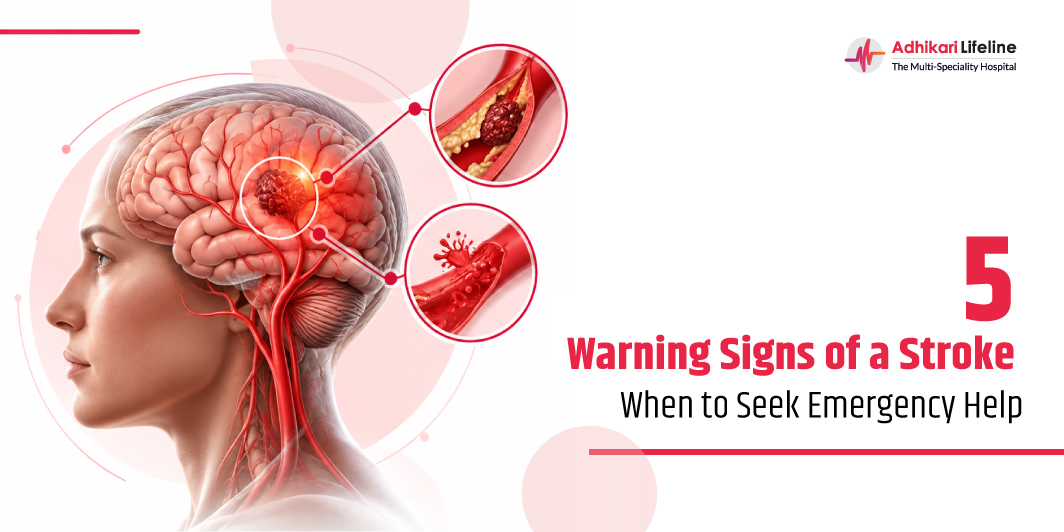
Picture an ordinary evening at home. Your loved one is telling you about his day, and halfway through a sentence his words start to slur. He laughs and says he is just tired. Then he reaches for his tea and his right hand will not close around the cup.
A stroke can begin exactly like this, quietly and without any warning.
At Adhikari Lifeline Hospital, we understand how frightening it can be when a loved one suddenly shows signs of a stroke. In those moments, it is natural to feel confused or unsure about what to do. But knowing the signs of a stroke can help you recognise that something is wrong and take action without delay. And when it comes to a stroke, every minute matters. In this blog, we will help you understand the warning signs and what you should do if someone around you experiences them.
What Is a Stroke and Why Does It Happen?
Your brain needs a constant supply of blood to get the oxygen and nutrients it needs to work properly. When this blood supply is suddenly blocked or a blood vessel in the brain bursts, it causes a stroke.
There are two main types of stroke:
Ischemic Stroke: This is the most common type of stroke. It happens when a blood clot blocks a blood vessel, stopping blood from reaching a part of the brain.
Hemorrhagic Stroke: This happens when a blood vessel in or around the brain bursts, causing bleeding that can damage nearby brain tissue.
In both cases, the affected brain cells can begin to get damaged within minutes because they are not receiving enough oxygen or are being affected by bleeding. That is why a stroke needs immediate medical attention. Waiting for the symptoms to go away can lead to serious complications, including permanent disability.
5 Warning Signs of a Stroke You Should Never Ignore
1. Sudden Weakness or Numbness
An arm may feel heavy, or a leg may refuse to hold your weight. Someone might drop a phone or a cup and not understand why. The face, arm or leg can be affected, and it usually happens on one side only. Think of a person who is chopping vegetables when her left hand suddenly goes limp. They may shake it and assume it has “fallen asleep.” But ordinary numbness fades quickly and usually has an obvious cause, like sitting in one position for too long. Weakness that comes on suddenly, with no clear reason, is different. If it does not settle within a minute or two, treat it as an emergency.
2. Facial Drooping
Ask the person to smile. If one corner of the mouth sags or the smile looks uneven, take it seriously. The person often cannot feel it, so a family member usually notices first. You may also see one eye looking droopy, or notice that the person cannot lift both sides of the mouth equally. Some people say their face “feels strange” or heavy. Do not be put off if they say they feel fine. Facial changes can appear before anything else, and a quick smile check takes only a few seconds.
3. Difficulty Speaking or Understanding Speech
Speech may sound slurred, or simple words may suddenly go missing. Some people look confused and cannot follow what you are saying, even though they are listening closely. A person may say a sentence that makes no sense, or call everyday objects by the wrong name. Others know exactly what they want to say but cannot get the words out. This can be frightening for them, and they may become upset or embarrassed. Stay calm, speak gently, and do not wait to see if it improves.
4. Sudden Vision Problems
Vision may turn blurry or double. It can also fade or disappear in one or both eyes. A person might say that part of their vision looks dark or missing, or that they suddenly cannot read what is in front of them. They may bump into doorways or furniture they would normally avoid. Because vision problems can seem like tired eyes or a need for new glasses, they are easy to dismiss. When they come on suddenly, especially with any other symptom on this list, get medical help right away.
5. Sudden Dizziness, Loss of Balance or Severe Headache
Walking may feel unsteady, or the room may spin. A sudden and very severe headache, especially along with other stroke symptoms, needs urgent attention.
Someone may stumble while crossing the room, hold onto walls for support, or feel that their legs are not following their commands. Dizziness alone has many harmless causes, but dizziness that arrives suddenly with poor coordination is a different matter. A stroke headache is often described as unusually intense and unlike any headache the person has had before. Do not try to sleep it off or take a painkiller and wait.
Not everyone has all five. Even one is reason enough to act. These stroke signs are warnings, not a diagnosis. Only a doctor, with proper tests, can confirm a stroke.
An easy way to remember them is B.E. F.A.S.T.
- B (Balance): Sudden loss of balance or coordination.
- E (Eyes): Sudden vision changes.
- F (Face): One side of the face droops.
- A (Arms): One arm becomes weak.
- S (Speech): Speech is slurred or difficult.
- T (Time): Call emergency medical services immediately.
What Should You Do If Someone Shows Stroke Symptoms?
Call an ambulance or your local emergency number immediately. Do not wait to see if the symptoms go away. We also recommend choosing an emergency hospital in advance and keeping its contact number saved and easily accessible. This can save valuable time during an emergency.
Make a note of when the symptoms first appeared or when the person was last seen well. Doctors use this information to determine the most appropriate treatment.
Do not give food, water, aspirin or any other medicine unless a doctor tells you to. Swallowing may be unsafe, and the type of stroke matters. If the symptoms disappear within minutes, still go to the hospital. This may be a transient ischemic attack (TIA), a temporary blockage that can be a warning of a bigger stroke to come.
Emergency Ambulance Helpline For Boisar Residents: 7028774444
Available 24 hours a day. 7 days a week. Every day of the year.
Who Is at Greater Stroke Risk?
Some health conditions and habits raise the chance of a stroke. Knowing these stroke risk factors helps you understand your own health and that of your family. Here are the most common ones:
- High blood pressure: This is one of the biggest risk factors. Over time, high pressure can weaken or damage the blood vessels in the brain. Many people have it without any symptoms, so regular blood pressure checks matter.
- Diabetes: High blood sugar can damage blood vessels over the years and make clots more likely. Keeping sugar levels under control, as advised by your doctor, lowers this risk.
- Smoking: Smoking, including chewing tobacco, narrows blood vessels and makes the blood more likely to clot. Quitting helps, and the benefit begins sooner than most people expect.
- High cholesterol: Excess cholesterol can build up inside the arteries and restrict blood flow to the brain. A simple blood test can show where your levels stand.
- Atrial fibrillation (an irregular heartbeat): When the heart does not beat in a steady rhythm, blood can pool and form clots. These clots can travel to the brain and block a blood vessel. Some people feel palpitations, while others notice nothing at all.
- Physical inactivity: A mostly sitting lifestyle makes it harder to manage weight, blood pressure and sugar levels. Regular movement, such as a daily walk, is a good place to start.
- A previous stroke or TIA: Anyone who has had a stroke or a transient ischemic attack (TIA) is at higher risk of another one. Follow up with your doctor and take prescribed medicines regularly.
Strokes can also happen to people with none of these factors, including younger adults who feel healthy. That is why every family benefits from knowing the warning signs.
Recognise a Stroke Early. Get Medical Help Immediately.
A stroke can change a family’s life in a matter of minutes, but knowing the signs of a stroke gives you a real chance to act in time. Sudden weakness on one side, a drooping face, slurred speech, vision changes or a loss of balance are never things to wait out. If you notice any of them in someone you love, call for emergency help immediately. Do not wait for an appointment or for the symptoms to pass.
At Adhikari Lifeline Multispeciality Hospital in Boisar, families can reach a Neurologist in Boisar and our Neurology department in Boisar for evaluation and care. Diagnostic facilities such as CT scans and blood tests are available, and our ER team, which includes Emergency Medicine Physicians, is ready to assess patients with a suspected stroke.
For stroke care in Boisar, you do not have to look far.
Emergency Helpline For Boisar Residents: 7028774444
We hope you never need this information. But if the moment comes, you will know what to do.
For information about neurology consultations, diagnostic facilities and emergency services in Boisar, feel free to connect with our hospital in Boisar.
Leave A Comment