

February 24, 2026 By Adhikari Lifeline No comments yet
Have you ever felt your heart race and wondered if it’s something serious? Or maybe you’ve experienced chest discomfort but brushed it off as stress or acidity? We often ignore small warning signs, until it’s too late.
At Adhikari Lifeline Hospital, our dedicated cardiology department is deeply committed to creating awareness about heart diseases and the importance of early detection. Many people believe heart problems always come with sudden, dramatic symptoms, but that’s not always true. In reality, heart disease often begins quietly, with subtle signs that are easy to overlook. It whispers before it shouts.
This is exactly where ECG monitoring plays a crucial role. Let’s understand this better.
What is an ECG?
An ECG, or electrocardiogram, is a medical test that records the electrical activity of your heart. Think of your heart as a pump powered by electrical signals. Every time your heart beats, an electrical impulse travels through it, causing the muscle to contract and pump blood.
An ECG captures these signals and displays them as waves on a graph.
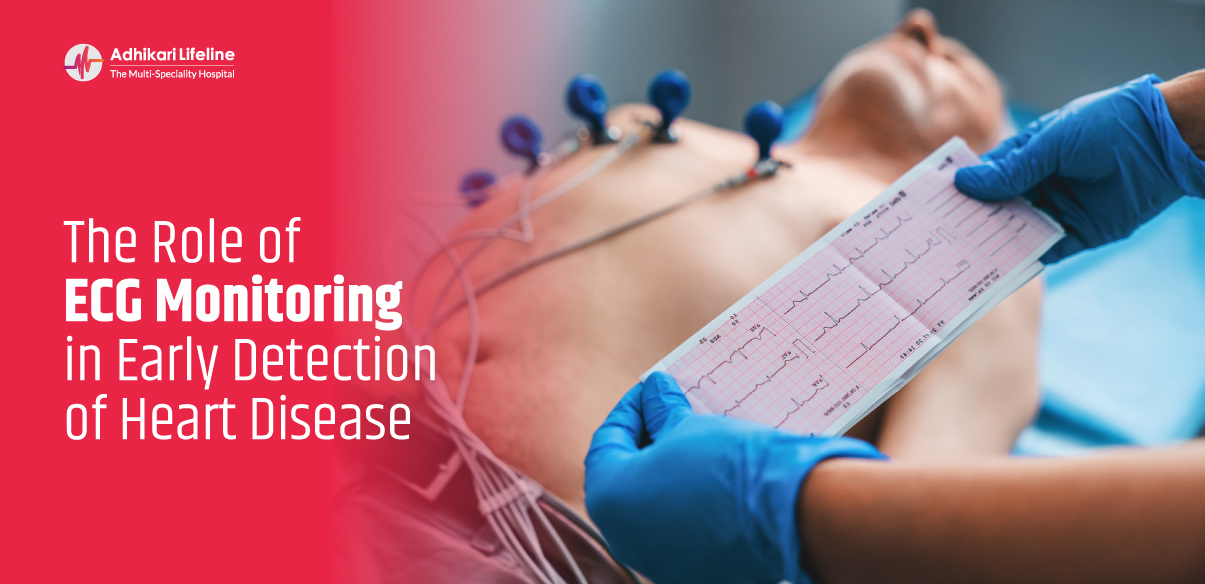
ECG is one of the quickest, most painless, and completely non-invasive tests you’ll ever take. Small sticky patches called electrodes are placed on your chest, arms, and legs. These electrodes pick up the electrical signals from your heart and send them to a machine that prints out a detailed report. The entire process takes just a few minutes, but the insights it provides can be life-changing.
An ECG measures:
- Heart rate – whether your heart is beating too fast, too slow, or irregularly
- Heart rhythm – detecting abnormal patterns that could signal danger
- Electrical impulses – identifying blockages or damage to the heart muscle
Now, you might be wondering: Is a one-time ECG enough? Not always.
What is ECG Monitoring?
What is ECG monitoring? While a standard ECG gives a snapshot of your heart’s activity at one moment, ECG monitoring involves continuous or repeated recording over hours, days, or even weeks. This is crucial because some heart problems don’t show up during a brief test. They happen during physical activity, sleep, or stress.
That’s where specialized monitoring comes in:
Holter Monitoring: You wear a small portable ECG device for 24 to 48 hours while going about your daily routine. It continuously records your heart’s electrical activity, capturing irregularities that might occur only occasionally.
Stress ECG (Treadmill Test): Your heart is monitored while you exercise on a treadmill or stationary bike. This reveals how your heart responds to physical exertion and can detect issues that don’t appear when you’re at rest.
Event Monitors: These are worn for weeks or months and activated when you feel symptoms like dizziness or palpitations.
Ongoing monitoring is vital because heart problems can be sneaky. A single ECG might miss an arrhythmia that only happens at night or a blockage that becomes evident only during exertion. It is highly recommended to consult a cardiologist for the best ECG monitoring method for you.
Understanding How to Read an ECG
Reading an ECG is a skill reserved for trained medical professionals, especially cardiologists. The wavy lines you see on an ECG printout represent different phases of your heartbeat. Each wave corresponds to a specific electrical event in your heart.
Doctors look for:
- Irregular rhythms (arrhythmias) – which can lead to stroke or sudden cardiac arrest
- ST-segment changes – signs of reduced blood flow or a heart attack
- Abnormal wave patterns – indicating heart enlargement, blockages, or previous damage
Let’s be clear: while you might find information online about ECG patterns, interpreting them requires years of medical training and clinical experience. Self-diagnosis can be dangerous. Always consult a qualified cardiologist who can analyze your ECG in the context of your symptoms, medical history, and other tests.
That’s where expert evaluation becomes non-negotiable.
Who Should Consider ECG Monitoring?
You don’t need to wait for severe symptoms to get your heart checked. Consider ECG monitoring if you:
- Experience chest pain or discomfort, even if mild
- Have high blood pressure or diabetes
- Have a family history of heart disease
- Are above 40 years of age
- Smoke, lead a sedentary lifestyle, or are overweight
- Feel palpitations, dizziness, or shortness of breath
- Are starting a new exercise program after a long break
Your heart works tirelessly for you, every single second of your life. Don’t you think it deserves a checkup?
The Benefits of Regular Cardiac Screening
Regular ECG monitoring and cardiac screening aren’t just medical procedures; they’re a way of taking care of yourself and the people who depend on you. Knowing your heart is healthy brings real peace of mind and allows you to live your life without that silent worry in the background. And if something isn’t quite right, catching it early gives you the power to act before it turns into something serious.
Timely detection can help prevent major complications like heart attacks and strokes, while also allowing your doctor to create a treatment plan that truly fits your body, lifestyle, and health history. In many ways, it’s like routine maintenance for the most important engine you’ll ever own, your heart.
Your Heart Deserves Expert Cardiac Care
If you’ve been ignoring that occasional chest tightness, those palpitations, or that nagging worry about your heart health, now is the time to act. Don’t wait for a warning sign. Don’t wait until it becomes an emergency.
At Adhikari Lifeline Multispeciality Hospital in Boisar, we understand that your heart is precious. Our advanced cardiology department is equipped with state-of-the-art ECG monitoring technology designed to detect even the subtlest signs of heart disease. We offer comprehensive cardiac care, including standard ECG, 2-D Echo and expert consultation with experienced cardiologists.
Our cardiologists in Boisar don’t just read reports; they listen to you. They take the time to understand your concerns, answer your questions with clarity, and guide you with care at every step of your heart health journey. Whether you’re coming in for a routine check-up or seeking help for troubling symptoms, you’ll receive compassionate, patient-centred care right here in Boisar. Give your heart the care it deserves by timely medical intervention.
Leave A Comment